In this post, you’ll learn how autonomous floor scrubbers are changing commercial cleaning — what they do, where they fit, and how Kärcher’s technology combines automation with proven cleaning performance.
The commercial cleaning industry is changing quickly. What once required an operator behind the wheel of a floor scrubber for an entire shift can increasingly be handled with the help of automation, intelligent navigation, and robotics.
Manufacturers like Kärcher are bringing autonomous cleaning technology into commercial floor care, giving facility managers another option when evaluating how to keep large spaces clean efficiently.
So, what can today’s robotic floor scrubbers actually do, and when does automation make sense?
From Traditional Scrubbing to Autonomous Cleaning
Walk-behind and ride-on floor scrubbers have already transformed how large facilities clean hard floors. Compared with manual cleaning, they let one operator cover significantly more floor space while scrubbing and recovering dirty water in a single process.
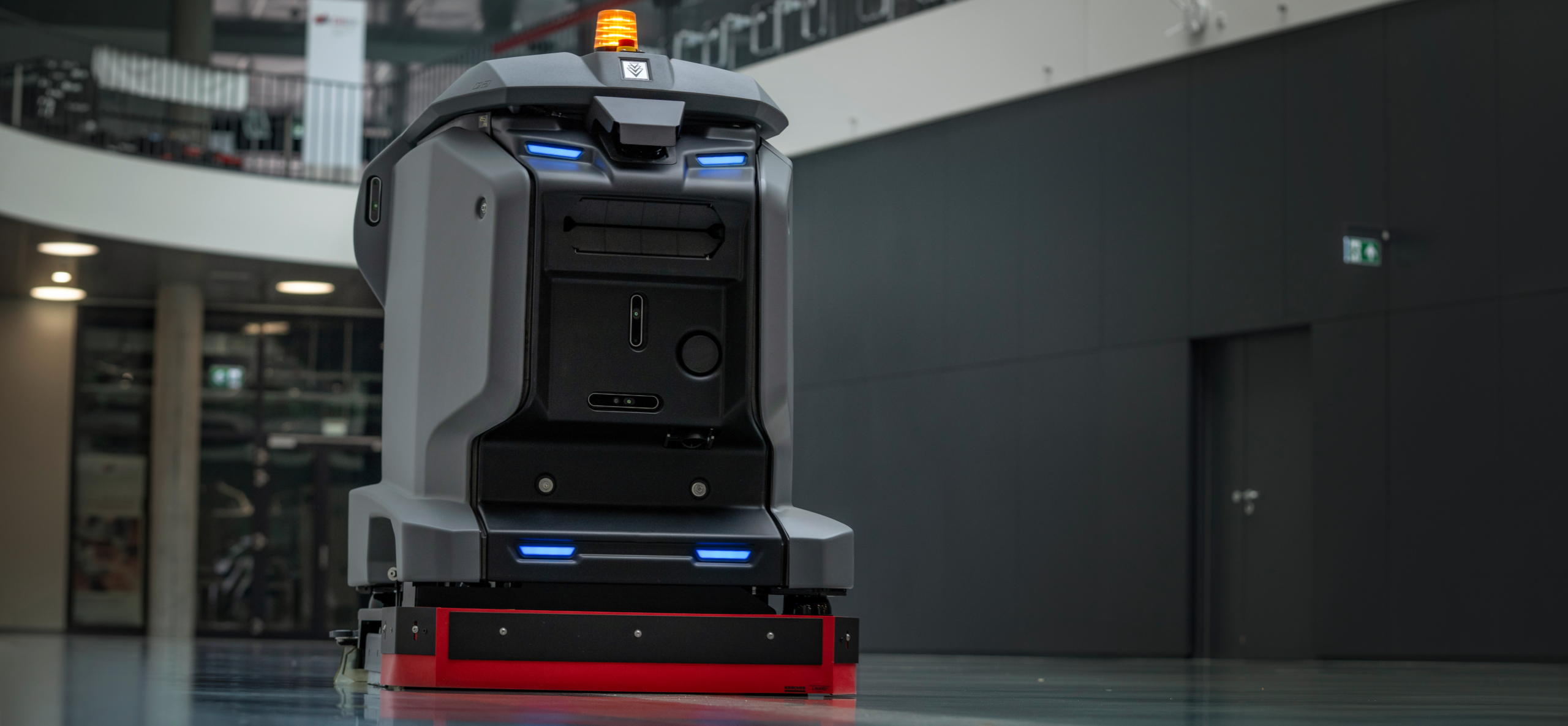
Autonomous floor scrubbers take that efficiency another step. Rather than requiring an employee to continuously operate the machine, robotic technology allows certain cleaning tasks and routes to be completed autonomously — freeing employees to focus on other areas of the facility while routine floor cleaning continues.
The goal isn’t simply to remove the operator. It’s to make better use of the people and equipment already available.
How Autonomous Floor Scrubbers Work
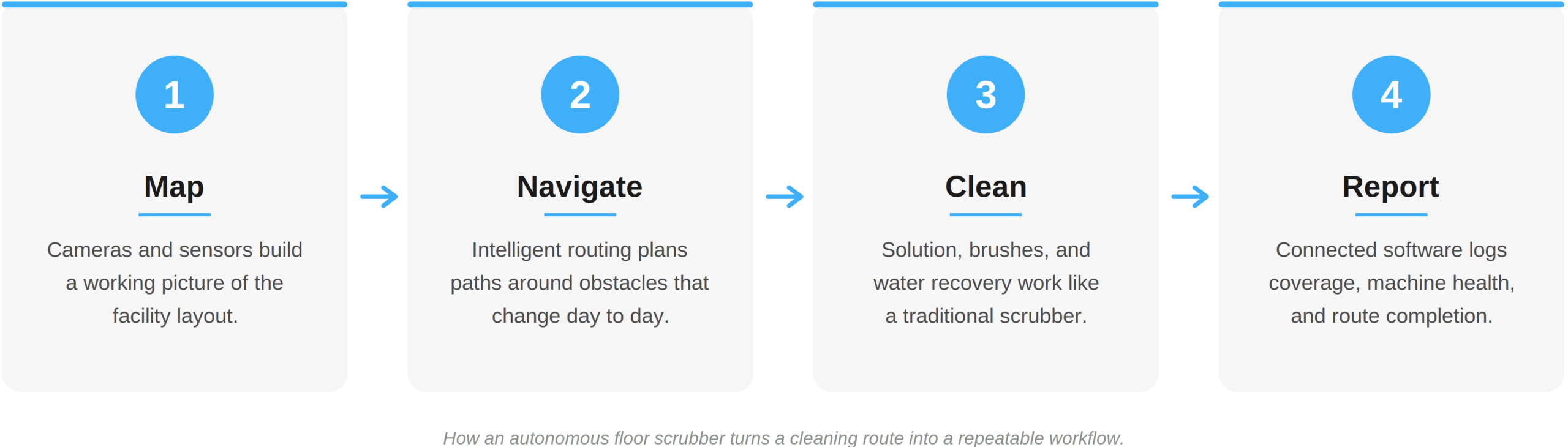
At its core, an autonomous floor scrubber still performs the same basic job as a traditional machine: applying cleaning solution, agitating the floor with brushes or pads, and recovering the dirty water.
The major difference is how the machine navigates.
Depending on the system, autonomous scrubbers can use:
- Cameras and sensors
- Mapping and localization technology
- Obstacle detection
- Intelligent route planning
- Connected software and reporting
These technologies let the machine understand its environment and perform routine cleaning with less direct operator involvement — especially valuable in large facilities where employees would otherwise spend hours repeatedly cleaning the same aisles and open floor areas.
Kärcher’s Approach to Autonomous Floor Cleaning
Kärcher has long been known for professional cleaning equipment, including commercial walk-behind and ride-on floor scrubbers. The company’s continued development of autonomous cleaning solutions represents the next step in that evolution.
Kärcher’s robotic floor-care technology combines professional cleaning performance with intelligent navigation designed specifically for commercial environments.
A robotic floor scrubber isn’t simply a robot that happens to clean. It still needs to perform the fundamental job of a commercial scrubber effectively — applying solution, agitating the floor, recovering dirty water, and leaving the surface ready for use.
Automation Frees Employees for Higher-Value Work
One of the biggest potential benefits of autonomous cleaning is labor productivity.
Imagine an employee responsible for maintaining a large warehouse. Driving a floor scrubber through the same open aisles every day can consume a significant portion of that shift. If an autonomous scrubber handles that repetitive portion of the cleaning routine, the employee can focus on work that requires more human attention.
This might include:
- Cleaning corners and difficult-to-reach areas
- Responding to spills
- Emptying trash and sanitizing high-touch areas
- Spot cleaning and facility inspections
- Preparing other areas for cleaning
The robot handles predictable floor coverage while the employee handles situations requiring judgment and flexibility. Automation isn’t about replacing the cleaning team — it’s about giving that team another piece of equipment to work with.
Smarter Navigation and Better Data
Commercial facilities present challenges a robotic machine has to handle. A warehouse aisle that was clear yesterday might have a pallet in it today. Employees cross cleaning routes. Forklifts move through the building. Displays, inventory, and equipment change position throughout the day.
Sensors and intelligent navigation help robotic scrubbers recognize their surroundings, detect obstacles, and respond appropriately when conditions change. As this technology continues to improve, autonomous equipment becomes practical in a wider variety of environments.
Another emerging trend is connected cleaning equipment. Traditionally, facility managers had relatively little information about what happened once a floor scrubber left the equipment room. Newer connected systems provide greater visibility into machine usage and cleaning activity — helping turn floor care into a more measurable part of facility operations.
Where Autonomous Cleaning Makes the Most Sense
Robotic floor scrubbers aren’t automatically the best solution for every building. They tend to make the most sense where there are large areas of repetitive hard-floor cleaning.
Strong-fit applications include:
- Warehouses and distribution centers
- Manufacturing plants
- Large retail facilities
- Airports
- Schools and universities
- Hospitals and healthcare facilities
- Convention centers
Facilities with smaller floor areas, extremely congested spaces, frequent layout changes, or highly specialized cleaning requirements may get better value from a traditional walk-behind or ride-on scrubber. That’s why evaluating the application matters more than chasing the newest technology.
Traditional Scrubbers Aren’t Going Away
With all the attention surrounding robotics, it’s easy to assume every facility will eventually switch to autonomous machines. That’s unlikely.
Traditional walk-behind and ride-on scrubbers remain extremely effective, and for many applications they’re still the best solution. A smaller facility may need the flexibility of a walk-behind Kärcher scrubber. A large facility with an experienced operator may benefit from the productivity of a ride-on machine. Another operation may have repetitive routes where autonomous technology fits. Some facilities may ultimately use all three.
The future of floor care isn’t traditional versus robotic.
It’s about having the right machine for each part of the job – and, in many operation, using both together.
Service Still Matters — Even When the Machine Is Smart
Advanced technology doesn’t eliminate the fundamentals of equipment maintenance. An autonomous floor scrubber is still a working piece of commercial cleaning equipment. Brushes and pads wear. Squeegees need replacement. Batteries require attention. Tanks and recovery systems need care.
Robotic equipment also introduces additional technology that makes knowledgeable support even more important.
When evaluating floor-care equipment, businesses should consider more than the initial machine specs. Parts availability, preventative maintenance, training, and local service can have a major impact on long-term value. A sophisticated machine isn’t very productive when it’s sitting unused waiting for service.
The Future: People and Technology Working Together
The biggest change robotics may bring to commercial cleaning isn’t replacing people. It’s changing how people spend their time.
Routine, repetitive cleaning is well suited to automation. Detailed cleaning, inspections, problem solving, and responding to unexpected situations still benefit enormously from human judgment. Instead of asking how many labor hours it takes to clean a building, facility managers can begin thinking about the most productive combination of employees, traditional equipment, and autonomous technology.
The Bottom Line
Automation and robotics are opening a new chapter in commercial floor care.
Intelligent navigation, sensors, connected technology, improved batteries, and autonomous operation are making it possible to automate portions of floor cleaning that traditionally required continuous operator involvement.
For large facilities dealing with repetitive cleaning routes or labor challenges, the potential is significant.
But newer isn’t automatically better.
The right solution may be an autonomous scrubber, a traditional Kärcher walk-behind or ride-on machine, or a combination of technologies. What matters is matching the equipment to the facility, cleaning requirements, workforce, and budget.The biggest change robotics may bring to commercial cleaning isn’t replacing people. It’s changing how people spend their time.Routine, repetitive cleaning is well suited to automation. Detailed cleaning, inspections, problem solving, and responding to unexpected situations still benefit enormously from human judgment. Instead of asking how many labor hours it takes to clean a building, facility managers can begin thinking about the most productive combination of employees, traditional equipment, and autonomous technology.
Interested in Kärcher Floor-Care Technology?
Whether you’re replacing an existing floor scrubber, improving your facility’s cleaning program, or interested in learning whether autonomous floor cleaning makes sense for your operation, H2O Power Equipment can help.
Our team can help you evaluate your facility size, floor type, cleaning frequency, labor requirements, and operating environment to identify the Kärcher floor-care solution that best fits your needs.
From traditional commercial floor scrubbers to emerging autonomous cleaning technology, the goal is the same: cleaner floors with a system that makes sense for your operation.
Denver Headquarters
H2O Power Equipment | (303) 287-7561 | Mon–Fri: 7:30 AM – 4:30 PM
Colorado Springs
H2O Power Equipment | (719) 434-4779 | Mon–Fri: 7:30 AM – 4:00 PM